Nov 2, 2026 · By: Nate Tanner
Understanding Balloon Payments in Seller Financing
When the financing for your home is provided by the seller, the seller generally doesn't want to be the bank for a long period of time. That's why it's worth understanding one term you'll often see in seller-financed deals: the balloon payment.
What Is a Balloon Payment?
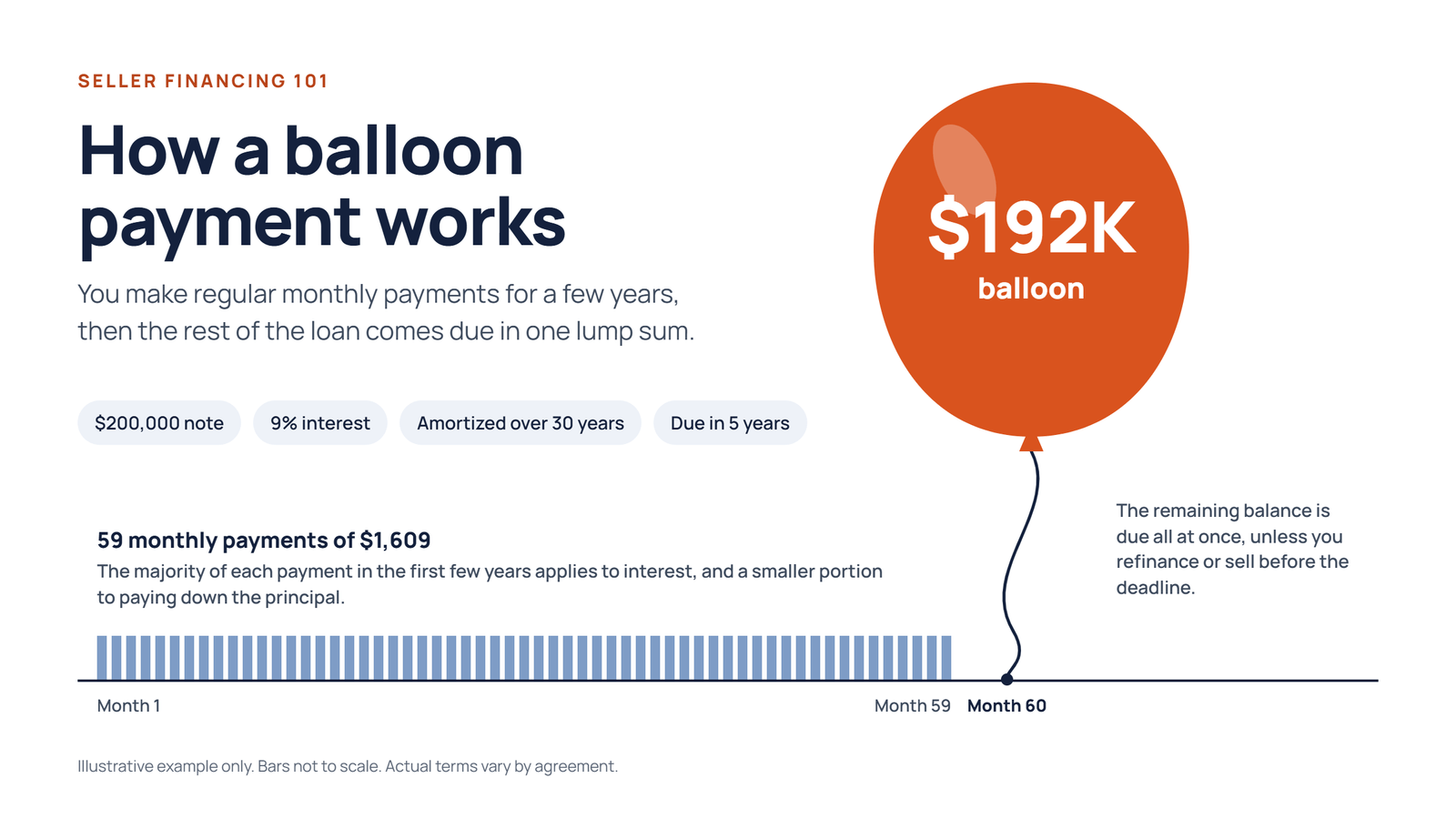
Some seller-financed agreements are set up with a relatively short term, which can be 18 months, 3 years, 5 years, etc. During that term, you make regular monthly payments, but those payments are not sufficient to fully pay off the loan. At the end of the term, whatever balance remains comes due all at once. That lump sum is called the balloon payment.
For example, imagine a loan with a balance structured so that after 5 years of monthly payments, $192,000 is still owed. At the end of year five, that $192,000 would need to be paid in full.
Why It Matters
Most buyers don't have $192,000 sitting in savings when that date arrives. The usual plan is to refinance with a traditional mortgage lender before the balloon payment comes due. That means you'll need to qualify under whatever lending rules and interest rates exist at that future date, not today's. This year's interest rate swings are a good reminder that those conditions can shift significantly in just a few years.
When There's No Balloon
Not every seller-financed loan works this way. A fully amortizing loan, for instance one structured over a traditional 30-year schedule, is set up so that your regular monthly payments gradually pay off the entire balance over the life of the loan. Nothing is left over to pay in one lump sum at the end. That structure removes the pressure of needing to qualify for a new bank loan down the road, since the seller-financed loan simply continues until it's paid off. At Hassle Free Homes, we offer 30-year seller financing that works just like that.
Questions Worth Asking
Before agreeing to any seller-financed deal, it's worth asking:
- Is the loan fully amortizing, with no balance due at the end?
- Or is there a balloon payment built into this loan?
- If there is a balloon payment, when is it due and roughly how much will it be?
- Can the loan be paid off early without a penalty?
Understanding the answers up front helps you plan with confidence, whether your loan has a balloon payment or not.